David and Goliath
The RainmakerDavid and Goliath is the organizing image Rudy Baylor uses to present the Black family’s case against Great Benefit Life Insurance Company: a lone, inexperienced lawyer and a vulnerable client facing a wealthy insurer and its formidable legal team. The contrast is more than courtroom appearance. It gives the jury a way to understand the unequal resources behind the dispute, while Baylor’s evidence turns that imbalance into a concrete account of how the company handled claims and what its decisions meant for Donny Ray Black.
The Imbalance Behind the Metaphor
Before trial, Max Leuberg describes the economics of debit insurance, a form of low-cost coverage sold door to door to low-income customers. Agents collect premiums regularly, but insurers, he says, routinely find reasons to deny claims. Leuberg estimates that only about one in thirty bad-faith denials reaches court, because people with limited means may be wary of lawyers and the legal system. For a company, the small chance of being sued can become part of the calculation behind denying a claim.
Leuberg also explains why a lawsuit alone may not level the field. In his account, juries can award medical costs while granting little in punitive damages, even when the insurer is far wealthier than the claimant. He illustrates the problem with a hypothetical: a claimant has five thousand dollars in covered bills, while the insurer is worth two hundred million. A jury might award the bills and only a small additional penalty. The legal remedy may therefore acknowledge a wrong without imposing a financial consequence large enough to change a corporation’s incentives.
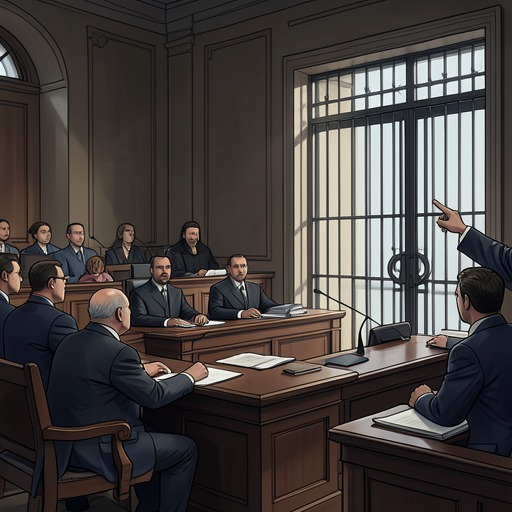
The trial makes that general imbalance visible. Baylor and Dot Black sit together at a largely bare table, with only a legal pad in front of them. Across the aisle, five unsmiling defense lawyers work over piles of papers; company representatives sit behind them, bringing the defense presence to seven suited men. Dot appears frail beside the corporate team. Baylor recognizes that jurors may read this arrangement as a disparity in power, and deliberately makes that contrast part of his presentation.
Turning Appearance into a Trial Strategy
Baylor’s visual framing does not replace proof. It prepares the jury to see the case as a contest between an individual family and a corporation with far greater resources. Once discovery is complete, he considers the defense team’s size unnecessary and potentially damaging to its client: five capable lawyers facing one rookie may make the company appear intimidating, or suggest that it has something to defend. What looks like Baylor’s weakness can therefore become an argument about the scale of the opposition.
The first clash over that framing comes in opening statements. Leo F. Drummond stresses that the policy costs eighteen dollars a week and, in his account, does not cover bone marrow transplants. He presents the Black family’s demand for the transplant cost and punitive damages as excessive. Baylor objects when Drummond moves into argument, and Judge Kipler sustains the objection. The brief ruling gives Baylor what he regards as the first advantage in the courtroom, while establishing that the case will turn on the evidence rather than the defense’s characterization of the family’s claim.
The policy itself complicates Drummond’s position. It excludes several kinds of organ transplants but does not mention bone marrow; a later version obtained by Baylor contains an exclusion that the policy at issue lacks. Drummond nevertheless argues that bone marrow transplants are unreliable and not accepted routine treatment, repeating that the procedure is not covered. Baylor’s presentation can thus challenge the defense on two fronts: what the policy says and whether the treatment was medically justified.
Evidence Makes the Conflict Legible
Dot’s testimony supplies the human and documentary center of Baylor’s case. She describes trying to find help for her dying son by contacting Great Benefit, public officials, and hospitals, and by asking friends and neighbors to raise money. She identifies the policy and explains the weekly premium collections. Then she reads the first seven denial letters, which give shifting explanations: review by the other department, a preexisting condition, Donny Ray’s status as an adult outside the household, lack of coverage, and the claim that the procedure is experimental. The letters make the company’s handling of the claim tangible rather than abstract.
When Dot reads the final, insulting letter, the jury’s response changes the atmosphere in the room. Some jurors look stunned; others turn toward the defense table. At Baylor’s request, Dot reads it a second time. He then ends her testimony before the defense can displace the force of that moment. The sequence links the disparity the jury has already seen to the experience of a particular insured family, and lets the written record carry much of the argument.
Cooper Jackson’s account of another insurer’s claims process helps Baylor recognize how the Black family’s file may fit a wider procedure. Jackson describes post-claim underwriting in which a handler first denies a claim, requests years of medical records, and sends the file between claims and underwriting. The two departments exchange further denials and instructions while the insured receives more letters and waits. Jackson says the departments may operate in the same company yet remain isolated from one another, and that many policyholders give up before consulting a lawyer. He shows Baylor organized storage boxes and manuals; Baylor finds that the Section U material in Jackson’s copies is absent from the manuals obtained in discovery.
Jackie Lemancyzk’s testimony makes the alleged practice more specific. She says that beginning January 1, 1991, the company adopted a twelve-month experiment under which claims over one thousand dollars were denied initially, regardless of their legitimacy. She estimates that the scheme generated about forty million dollars in additional money. She also testifies that the Black claim was monitored after the company recognized the acute leukemia diagnosis, that the policy did not exclude bone marrow transplantation, and that company personnel knew Donny Ray’s illness was terminal without it. Her account connects the company-wide procedure to the knowledge and decisions surrounding this particular claim.
Baylor later confronts Kermit Aldy with the missing Section U in the underwriting manual. Aldy confirms that the section was removed from the copy Baylor received and describes it as a system of checks and balances. Baylor then produces the complete manual. The recovered section makes the exchange between claims and underwriting part of the evidence the jury can inspect, rather than a process the company can leave unexplained.
A Story for the Jury
The trial’s evidence gains force through its arrangement. Denial letters show the changing reasons given to the family; Jackie’s testimony describes the broader policy and the company’s knowledge; the manuals expose the written procedures; and Donny Ray’s recorded testimony makes the consequences personal. The edited deposition runs for thirty-one minutes. As the courtroom watches, the jurors lean toward the screen, Dot wipes her cheeks, and the room remains quiet after the image disappears. The case’s financial and administrative details have become inseparable from the person who endured their consequences.
In closing, Baylor presents himself not as an experienced courtroom performer but as a nervous rookie asking the jurors to consider what happened to his clients. He recalls the absence of contrary medical evidence to Dr. Walter Kord’s testimony and argues that a transplant could have saved Donny Ray’s life. He then uses Great Benefit’s own figures to lay out the number of policies, claims, and denials in 1991, making the alleged year-long experiment easy to follow.
Baylor also puts the company’s resources on the chalkboard. Using its financial statements, he calculates four hundred and seventy-five million dollars in available cash, reserves, and undistributed surpluses, against an admitted net worth of four hundred and fifty million. Rather than propose a specific punitive award, he compares corporate punishment to a penalty that would matter to an ordinary person. The comparison turns the disparity in wealth into a question of proportion: what consequence could actually get a company of that size to change its conduct?
Drummond offers a competing account, emphasizing the Black family’s monthly income of seven hundred and forty-six dollars and presenting a two-hundred-thousand-dollar payment invested at six percent as a way to increase that income. In rebuttal, Baylor stresses that the company had not acknowledged its error when the trial began and that its offer came only after the evidence had emerged. He tells the jurors they can reject the two-hundred-thousand-dollar figure if they do not believe the company’s conduct deserves punishment. The contest is therefore not simply between a small plaintiff and a rich defendant, but between two explanations of what the money means: assistance to a family or accountability for the company.
Significance and Limits
David and Goliath captures both the disadvantage Baylor faces and the method by which he tries to overcome it. His side has fewer lawyers and fewer visible resources; its strength lies in organizing the evidence so that the company’s procedures, financial incentives, and treatment of Donny Ray form one comprehensible account. The metaphor is enacted in the courtroom’s tables and reinforced by the paper trail, testimony, and financial figures.
The image does not make victory automatic. Leuberg’s account of low punitive awards explains why even a strong case may not produce a consequence proportionate to the company’s wealth. Baylor’s closing argument accordingly asks the jury to connect its view of the evidence to the practical purpose of punishment. The passage ends with the jurors beginning deliberations, leaving the result unresolved in these scenes; the David-and-Goliath framing describes the stakes and strategy, not a guaranteed outcome.